Second Sunday in Lent
Grace
1Now there was a Pharisee named Nicodemus, a leader of the Jews. 2He came to Jesus by night and said to him, “Rabbi, we know that
you are a teacher who has come from God; for no one can do these signs that you
do apart from the presence of God.” 3Jesus answered him, “Very truly, I
tell you, no one can see the kingdom of God without being born from above.” 4Nicodemus said to him, “How can anyone be born after having
grown old? Can one enter a second time into the mother’s womb and be born?” 5Jesus answered, “Very truly, I tell you, no one can enter the
kingdom of God without being born of water and Spirit. 6What is born of the flesh is flesh, and what is born of the
Spirit is spirit. 7Do not be astonished that I said to
you, ‘You must be born from above.’ 8The wind blows where it chooses,
and you hear the sound of it, but you do not know where it comes from or where
it goes. So it is with everyone who is born of the Spirit.” 9Nicodemus said to him, “How can these things be?” 10Jesus answered him, “Are you a teacher of Israel, and yet you do
not understand these things?
11“Very truly, I tell you, we speak of what we know and testify to
what we have seen; yet you do not receive our testimony. 12If I have told you about earthly things and you do not believe,
how can you believe if I tell you about heavenly things? 13No one has ascended into heaven except the one who descended
from heaven, the Son of Man. 14And just as Moses lifted up the
serpent in the wilderness, so must the Son of Man be lifted up, 15that whoever believes in him may have eternal life.
16“For God so loved the world that he gave his only Son, so that
everyone who believes in him may not perish but may have eternal life.
17“Indeed, God did not send the Son into the world to condemn the
world, but in order that the world might be saved through him.”
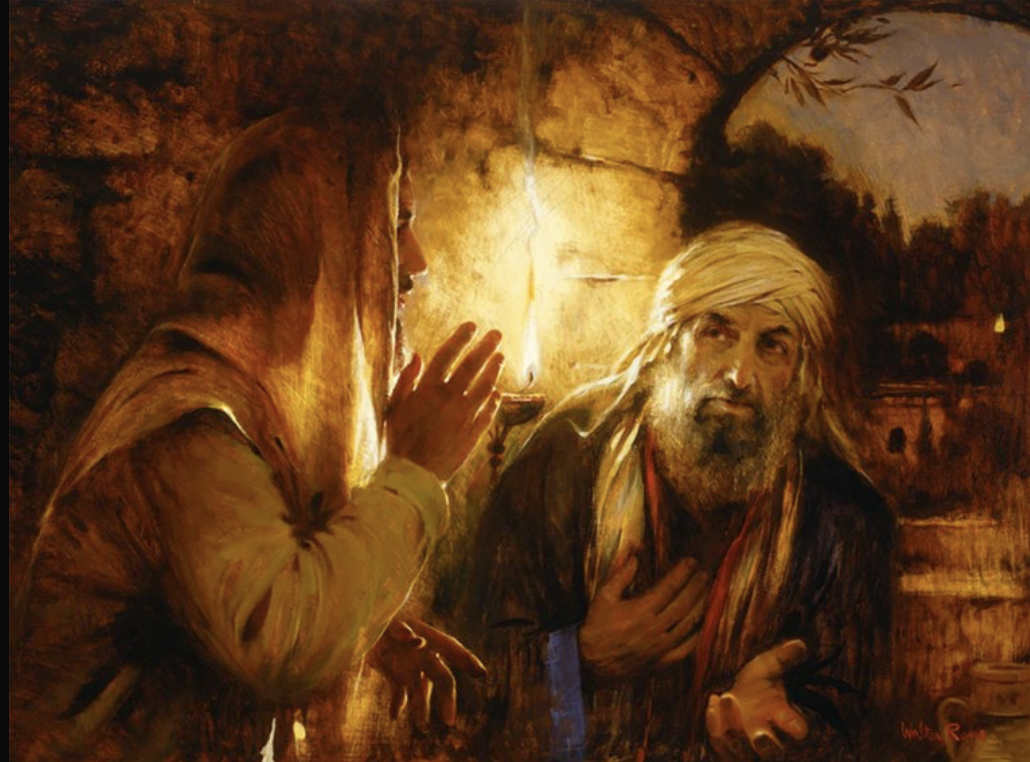
Nicodemus Came to Jesus by Night
RANE, Walter
Contemporary
Private Collection
United States
As
is the case with Lazarus, the figure of Nicodemus is not found in the synoptic
Gospels (Matthew, Mark, and Luke), and is only mentioned in the gospel of John.
As one of the Pharisees, Nicodemus did not want to jeopardize his position and
his reputation by being seen publicly with Jesus, so he surreptitiously visited
Jesus after nightfall. Nicodemus, an educated man, was moved by Jesus’
teachings and hungered for a deeper knowledge of the Lord.
- Lectionary Commentary and Preaching Paths (Lent A2), by Jirair
Tashjian, at The
Christian Resource Institute.
- "Nicodemus represents people who
carefully and cautiously must examine the new things that God may be
doing and subject these to painstaking scrutiny in light of past
traditions and experiences before jumping in and embracing them. We must
allow people to respond to God in a variety of ways rather than
prescribing a single mode.”
-
|

I would rather have a mind
opened by wonder
than one closed by belief.
~ Gerry Spence
Grace, then, is
grace, — that is to say, it is sovereign,
it is free, it is
sure, it is unconditional,
and it is everlasting.
~ Alexander Whyte
Chili
Cook-off at church last Sunday
THE
WINNING CHEFS!

Jenny
Snyder, David Holden, Heidi Smithson, Julia Holden

Female
elk resting off my patio

Closer
view
Our
lives are fragmented. There are so many things to do, so many events to
worry about, so many people to think of, so many experiences to work through,
so many tasks to fulfill, so many demands to respond to, and so many needs to
pay attention to. Often it seems that just keeping things together asks
for enormous energy. Different powers pull us into different directions
and our sense of unity and togetherness is constantly threatened. This
fragmentation is probably one of the most painful experiences of modern man and
women. … Life has become so busy … that it is hard to keep the pieces
together. Underneath… lurks the nagging feeling of being disconnected,
alienated and bored. … And so while we are busy we feel an inner emptiness.
~ Henri
Nouwen *
March 1, 2026 First Sunday of Lent - Year A
Previous
OPQs may be found at:
http://www.dotjack.com/opq.htm
* Henri Nouwen in
the Foreword to The
Practice of the Presence of God by Brother Lawrence

1What then are we to say was gained by Abraham, our ancestor
according to the flesh? 2For if Abraham was justified by
works, he has something to boast about, but not before God. 3For what does the scripture say? “Abraham believed God, and it
was reckoned to him as righteousness.” 4Now to one who works, wages are not
reckoned as a gift but as something due. 5But to one who without works trusts
him who justifies the ungodly, such faith is reckoned as righteousness.
13For the promise that he would inherit the world did not come to
Abraham or to his descendants through the law but through the righteousness of
faith. 14If it is the adherents of the law who are to be the heirs, faith
is null and the promise is void. 15For the law brings wrath; but where
there is no law, neither is there violation.
16For this reason it depends on faith, in order that the promise
may rest on grace and be guaranteed to all his descendants, not only to the
adherents of the law but also to those who share the faith of Abraham (for he
is the father of all of us, 17as it is written, “I have made you
the father of many nations”) — in the presence of the God in whom he believed,
who gives life to the dead and calls into existence the things that do not
exist.
Romans
4:1-5, 13-17
Agnus Day, by
James Wetzstein

Agnus Day appears with the permission of www.agnusday.org


LECTIONARY
Genesis
12:1–4a
Psalm
121
Romans
4:1–5, 13–17
John
3:1–17 or Matthew 17:1–9
THE WORD:
The Pharisee and teacher Nicodemus comes to Jesus in the middle of the night (in John’s Gospel, night/darkness symbolizes the lack of faith/light). A man of learning, Nicodemus is one of the Jewish elites who were favorably disposed toward Jesus but were struggling to grasp the full meaning of his teachings. For the writer of the Fourth Gospel, Nicodemus represents exactly the kind of timid disciple the evangelist seeks to persuade to come forward and openly profess his/her faith in Jesus as the Christ.
In their exchange, Jesus explains that the kingdom of God he proclaims transcends time and place, that God’s reign is a state of being: to enter the realm of God demands an interior transformation in the Spirit. Invocating the image of Moses’ staff of a bronze serpent raised to save the Israelites from the bite of poisonous snakes (Numbers 21:9), Jesus foretells his own crucifixion, when he will be “lifted up” for the glory of God and the salvation of humankind. And, in one of the most famous verses in John’s Gospel, Jesus speaks of a God who is motivated by love so great that the Father has given the world his own Son not to condemn but to save.
First Reading Genesis 12:1-4a
1Now
the LORD said to Abram, “Go from your country and your kindred and your
father’s house to the land that I will show you. 2I will make of you a great nation,
and I will bless you, and make your name great, so that you will be a blessing. 3I will bless those who bless you, and the one who curses you I
will curse; and in you all the families of the earth shall be blessed.”
4So Abram went, as the LORD had told him; and Lot went with him.
1 I lift up my eyes
to the hills —
from where will my
help come?
2 My help comes
from the LORD,
who made heaven and
earth.
3 He will not let
your foot be moved;
he who keeps you
will not slumber.
4 He who keeps
Israel
will neither
slumber nor sleep.
5 The LORD is your
keeper;
the LORD is your
shade at your right hand.
6The sun shall not strike you by
day,
nor the moon by
night.
7 The LORD will
keep you from all evil;
he will keep your
life.
8 The LORD will
keep
your going out and
your coming in
from this time on
and forevermore.
Second
Reading Romans 4:1-5, 13-17
1What
then are we to say was gained by Abraham, our ancestor according to the flesh? 2For if Abraham was justified by works, he has something to boast
about, but not before God. 3For what does the scripture say?
“Abraham believed God, and it was reckoned to him as righteousness.” 4Now to one who works, wages are not reckoned as a gift but as
something due. 5But to one who without works trusts
him who justifies the ungodly, such faith is reckoned as righteousness.
13For the promise that he would inherit the world did not come to
Abraham or to his descendants through the law but through the righteousness of
faith. 14If it is the adherents of the law who are to be the heirs, faith
is null and the promise is void. 15For the law brings wrath; but where
there is no law, neither is there violation.
16For this reason it depends on faith, in order that the promise
may rest on grace and be guaranteed to all his descendants, not only to the
adherents of the law but also to those who share the faith of Abraham (for he
is the father of all of us, 17as it is written, “I have made you
the father of many nations”) — in the presence of the God in whom he believed,
who gives life to the dead and calls into existence the things that do not
exist.
1Now
there was a Pharisee named Nicodemus, a leader of the Jews. 2He came to Jesus by night and said to him, “Rabbi, we know that
you are a teacher who has come from God; for no one can do these signs that you
do apart from the presence of God.” 3Jesus answered him, “Very truly, I
tell you, no one can see the kingdom of God without being born from above.” 4Nicodemus said to him, “How can anyone be born after having
grown old? Can one enter a second time into the mother’s womb and be born?” 5Jesus answered, “Very truly, I tell you, no one can enter the
kingdom of God without being born of water and Spirit. 6What is born of the flesh is flesh, and what is born of the
Spirit is spirit. 7Do not be astonished that I said to
you, ‘You must be born from above.’ 8The wind blows where it chooses,
and you hear the sound of it, but you do not know where it comes from or where
it goes. So it is with everyone who is born of the Spirit.” 9Nicodemus said to him, “How can these things be?” 10Jesus answered him, “Are you a teacher of Israel, and yet you do
not understand these things?
11“Very truly, I tell you, we speak of what we know and testify to
what we have seen; yet you do not receive our testimony. 12If I have told you about earthly things and you do not believe,
how can you believe if I tell you about heavenly things? 13No one has ascended into heaven except the one who descended
from heaven, the Son of Man. 14And just as Moses lifted up the
serpent in the wilderness, so must the Son of Man be lifted up, 15that whoever believes in him may have eternal life.
16“For God so loved the world that he gave his only Son, so that
everyone who believes in him may not perish but may have eternal life.
17“Indeed, God did not send the Son into the world to condemn the
world, but in order that the world might be saved through him.”